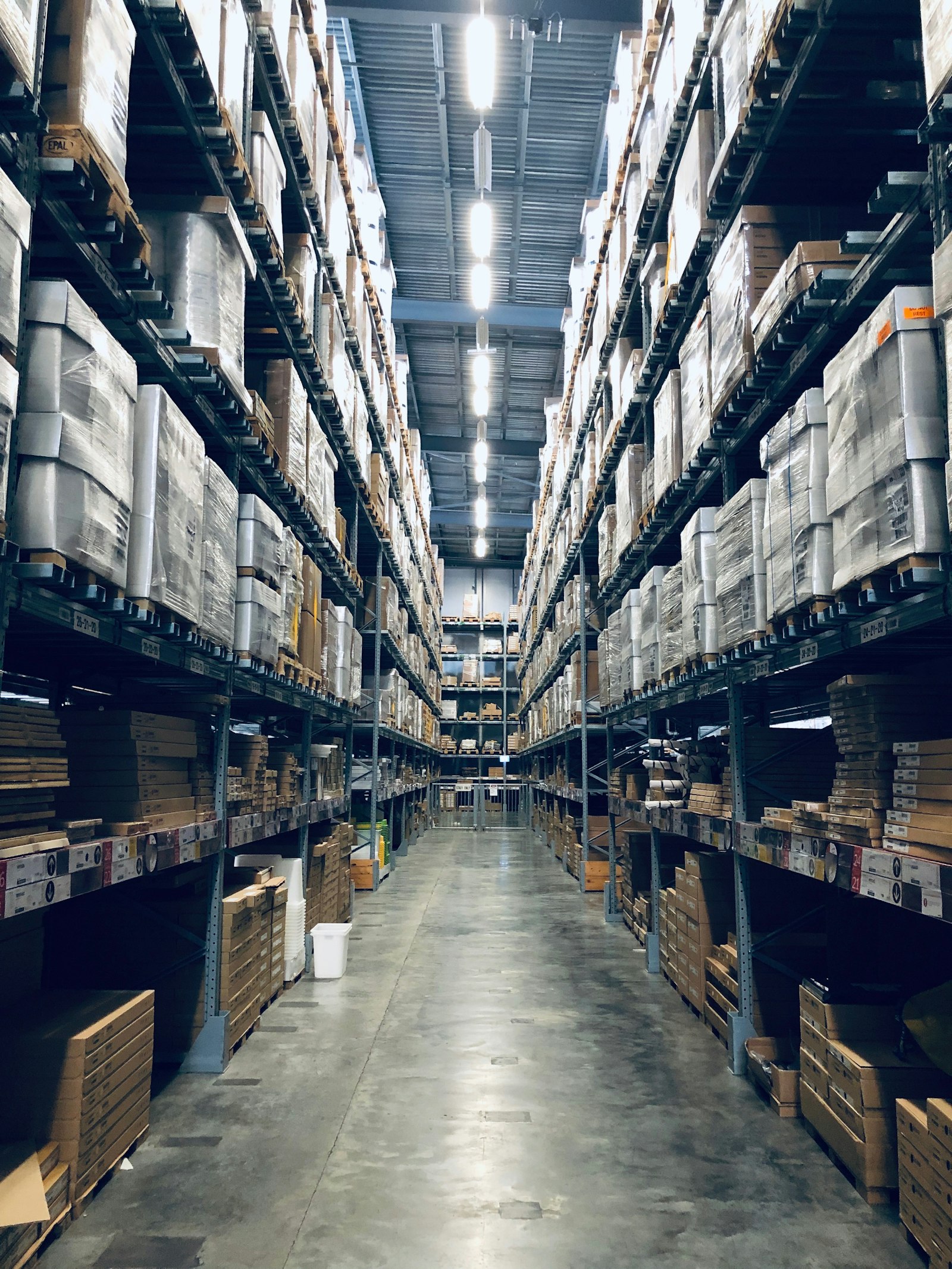
- 01Warehouse efficiency is set at layout stage: flow (U-shape, through-flow), racking density, aisle widths, and dock count define throughput and cost per pallet.
- 02Clear height is the cheapest capacity — going taller stores more pallets on the same footprint, but drives structure, sprinklers, and MHE choices.
- 03Racking type (selective, drive-in, push-back, ASRS) trades density against accessibility and must match the SKU/throughput profile.
- 04BIM coordinates structure, racking, sprinklers, and lighting so clearances and fire compliance are verified before build.
A warehouse is a flow machine. The best ones move goods from dock to storage to dispatch along short, non-crossing paths, store the most pallets per square metre the operation can handle, and do it in a building that’s cheap to build and run. All of that is decided at layout design — long before the first rack is bolted down.
Flow comes first
The layout starts from material flow. A through-flow layout (receiving one end, dispatch the other) suits high-volume linear operations; a U-flow (receiving and dispatch on the same side) shares dock resources and shortens travel for many distribution operations. The flow decision sets dock positions, aisle orientation, and where value-add areas sit.
Clear height: the cheapest capacity
Racking selection
- Selective racking: every pallet accessible; lowest density, highest flexibility — the default for varied SKUs.
- Drive-in / drive-through: high density for few SKUs, deep lanes, lower selectivity.
- Push-back and pallet-flow: dense with better rotation than drive-in.
- ASRS (automated storage/retrieval): maximum density and throughput in very high bays, at higher capital cost and tighter structural tolerances.
Coordinating structure, racking & fire
Racking, building structure, sprinkler heads, and high-bay lighting all share the same overhead space and must clear each other and meet fire code. In tall or automated warehouses this coordination is unforgiving — a sprinkler layout that ignores rack geometry, or a rack run that fouls a portal frame, is expensive to fix on site.
Designed to move
The difference between an average warehouse and an excellent one is decided in layout and coordination. Spetia Engineering designs the flow, racking, and building together in one model, so the finished warehouse hits its throughput and pallet targets without on-site surprises.