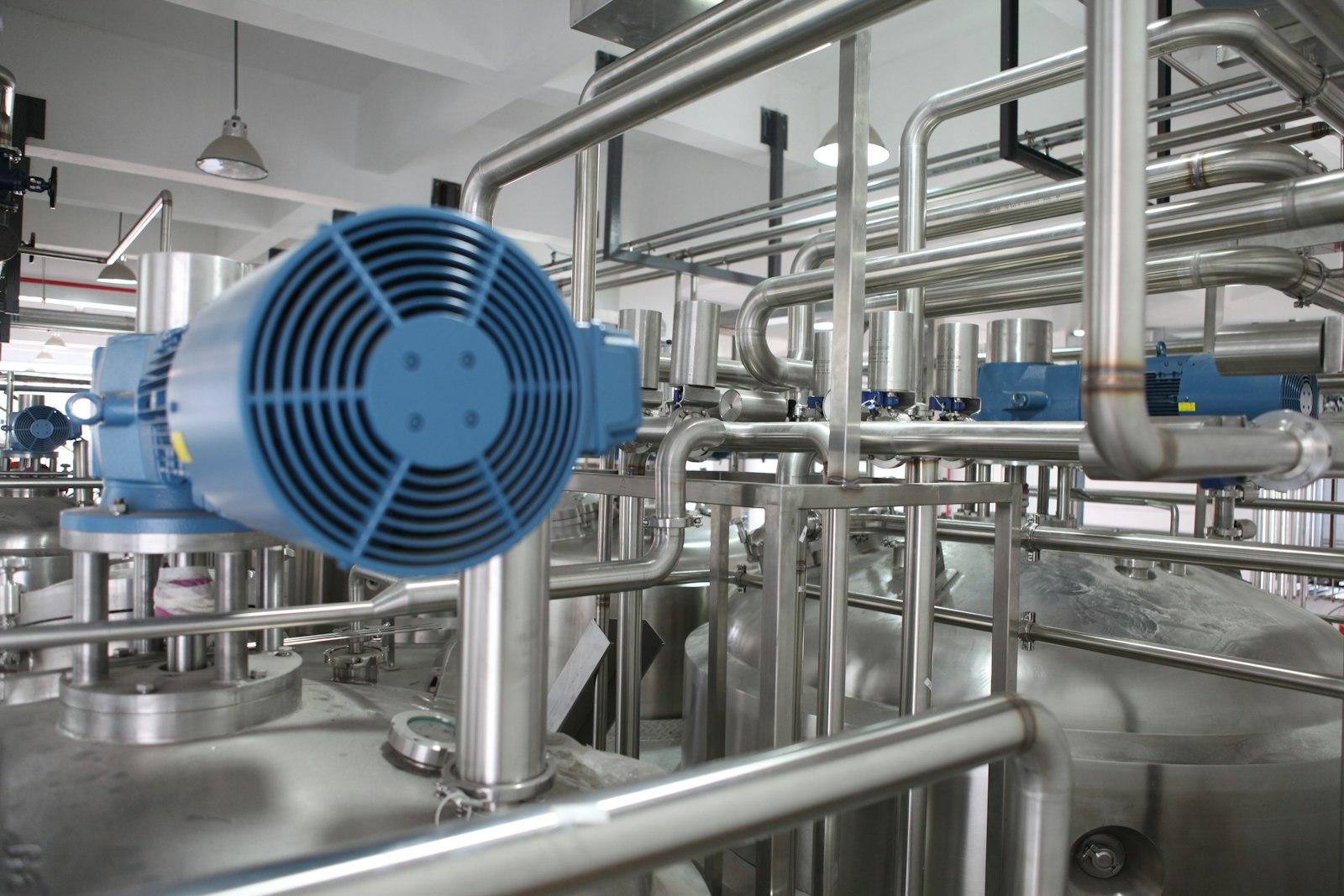
- 01A feed mill flows: intake & cleaning → grinding → batching & dosing → mixing → pelleting → cooling → screening → coating → bagging/bulk load-out.
- 02Batching accuracy and mixer homogeneity define feed quality; the layout must protect scale hoppers from vibration and give the mixer a clean gravity path.
- 03Tower (vertical) layouts dominate modern feed mills because gravity flow between grinding, batching, mixing, and pelleting minimises cross-contamination and conveying.
- 04The pellet line (conditioner → pellet press → cooler) is the throughput and energy bottleneck — size and coordinate it first, then design the tower around it.
- 05A 3D BIM layout resolves the dense equipment/structure/aspiration clashes of a feed tower before steel is cut, protecting both schedule and budget.
Feed mills are deceptively dense plants. Into a compact footprint you have to pack grinding, gravimetric batching, mixing, steam conditioning, high-pressure pelleting, cooling, and load-out — all connected by elevators, conveyors, and an aspiration network, and all stacked in a tower where gravity does the work. The feed mill 3D layout is where these systems either fit together cleanly or fight each other for space. This guide covers how we design feed mills for flow and uptime, and why the layout is a coordination problem best solved in a model.
Feed mill process flow
- 01Intake & cleaning
Raw materials (maize, soya, bran, additives) are received, cleaned of ferrous and coarse contaminants via magnets and screens, and routed to ingredient silos.
- 02Grinding
A hammer mill (or roller mill) reduces particle size to a target that suits both the animal and the downstream pellet quality. Grinding is the largest single electrical load.
- 03Batching & dosing
Ingredients are gravimetrically weighed into a batch on load-cell scale hoppers. Micro-ingredients are dosed separately for accuracy.
- 04Mixing
A paddle or ribbon mixer homogenises the batch. Mix uniformity (CV%) is a core quality KPI; liquids (fat, molasses) are added here.
- 05Conditioning & pelleting
Steam conditioning raises temperature and moisture, then a pellet press forces the mash through a die. Die specification sets pellet diameter and durability.
- 06Cooling & screening
A counter-flow cooler brings pellets to near-ambient temperature; a screener removes fines, which are recirculated.
- 07Coating, bagging & bulk load-out
Optional post-pellet liquid coating, then bagging or bulk truck load-out.
Why feed mills go vertical
Almost every modern feed mill is a tower layout. Ingredients are elevated once to the top, then gravity carries the flow down through batching, mixing, conditioning, and pelleting. This minimises the number of elevators and drag conveyors (each of which is a maintenance and contamination point), shortens the process, and keeps the footprint small on expensive industrial land.
- Gravity flow reduces cross-contamination between batches — essential for medicated or species-specific feeds.
- Fewer mechanical transfers means fewer failure points and less downtime.
- A compact footprint lowers land and foundation cost — but pushes complexity into the structural design of a tall, heavily-loaded tower.
- Bin arrangement above the batching scales must be coordinated with structure so support steel never blocks a discharge cone.
The coordination problem — and the 3D answer
A feed tower crams bins, scale hoppers, a mixer, conditioners, a press, a cooler, dozens of chutes, an aspiration network, and cable trays into a few tightly-stacked floors. In 2D, the clashes between these systems are almost impossible to catch until erection — and every clash found on site is a change order and a delay.
One model, every discipline
Spetia Engineering designs feed mills as a single coordinated package — process, structure, and MEP in one model — so the tower is verified buildable before fabrication starts. That upfront coordination is what keeps a dense, vertical plant on budget and on schedule.