- 01Dairy plants flow: reception & chilling → separation & standardisation → pasteurisation/UHT → homogenisation → processing (packaging, cheese, powder) → cold storage & dispatch.
- 02Everything is built around hygiene and the cold chain: sanitary stainless piping, clean-in-place (CIP), and unbroken refrigeration.
- 03Pasteurisation with heat regeneration recovers most of the heating energy — a core efficiency of the thermal design.
- 04Sanitary piping, CIP circuits, refrigeration, and structure are dense and best coordinated in a 3D model.
Milk is one of the most perishable and hygiene-sensitive products in food manufacturing, so a dairy plant is engineered end-to-end around two imperatives: keep it clean and keep it cold. From reception to dispatch, the process is a sequence of thermal and separation steps connected by sanitary stainless piping that must be cleanable in place and never break the cold chain. Dairy processing plant design is hygienic-process engineering at its most demanding.
The dairy processing flow
- 01Reception & chilling
Raw milk is received, tested, filtered, and immediately chilled (typically ~4 °C) to arrest bacterial growth before storage in insulated silos.
- 02Separation & standardisation
Centrifugal separators split cream from skim; the fat content is then standardised to the target for each product.
- 03Pasteurisation / UHT
Heat treatment (HTST pasteurisation or UHT) destroys pathogens. Regenerative heat exchange recovers most of the heating energy from the outgoing hot stream.
- 04Homogenisation
High-pressure homogenisation breaks up fat globules so cream does not separate on standing.
- 05Processing & packaging
Milk is packaged, or diverted to cheese, yoghurt, butter, or drying (milk powder) lines.
- 06Cold storage & dispatch
Finished product is held in refrigerated storage and dispatched under an unbroken cold chain.
Hygiene, sanitary piping & CIP
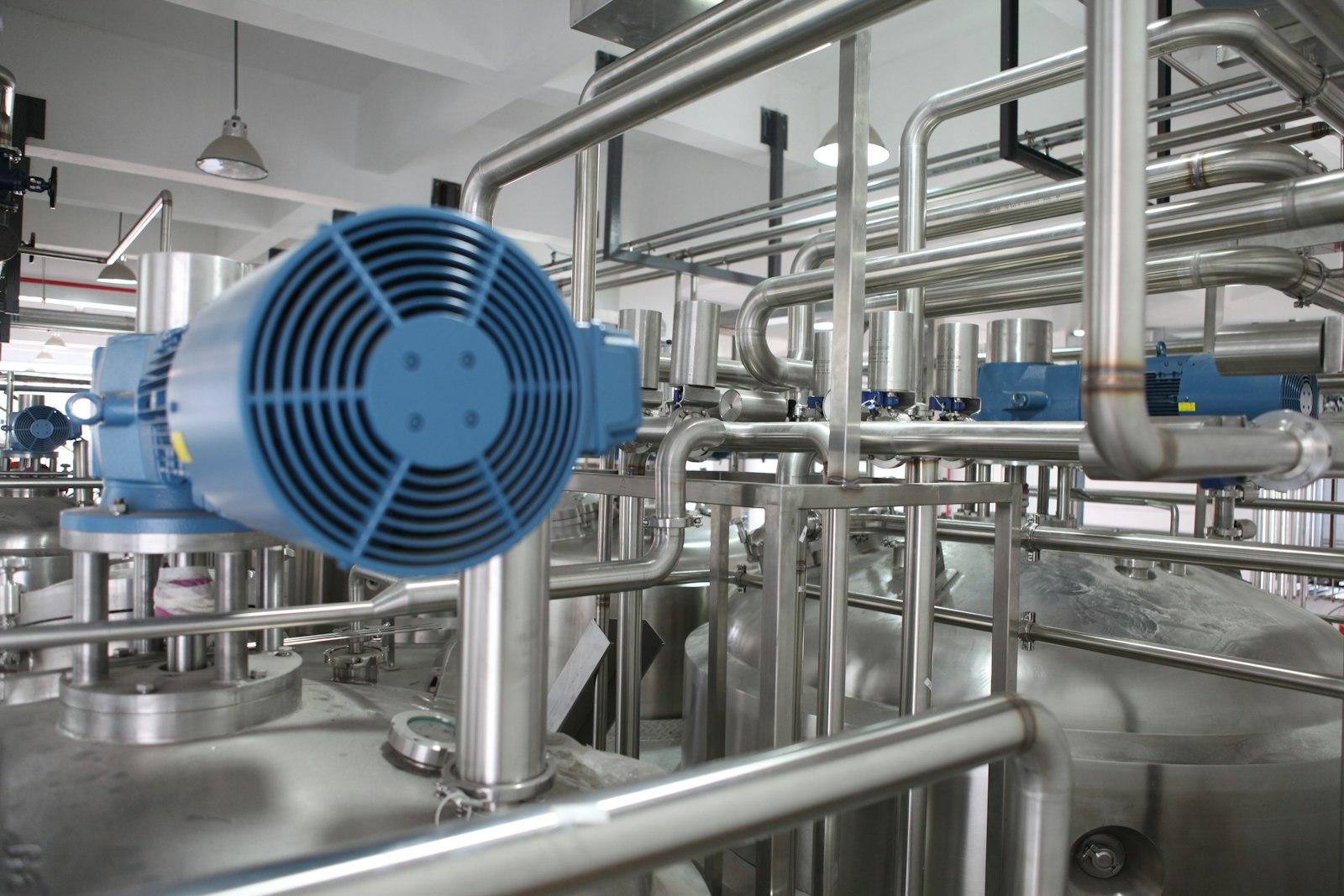
Like all product-contact dairy systems, the piping is sanitary: polished stainless, crevice-free joints, fully drainable, and designed as clean-in-place circuits with no dead legs. CIP is run frequently between production cycles, so the entire fluid network must be engineered for reliable, automated cleaning from day one.
- Sanitary 316L stainless tube with orbital-welded and hygienic-clamp joints.
- Full drainability and dead-leg elimination for effective CIP.
- Segregation of raw and pasteurised streams to prevent post-process contamination.
- Refrigeration and chilled-water systems sized to hold the cold chain through every step.
Clean, cold, and coordinated
A dairy plant succeeds on hygiene, cold-chain integrity, and thermal efficiency together. Spetia Engineering coordinates the sanitary process, refrigeration, and structure in one model, delivering a plant that passes audits, protects the cold chain, and runs efficiently.